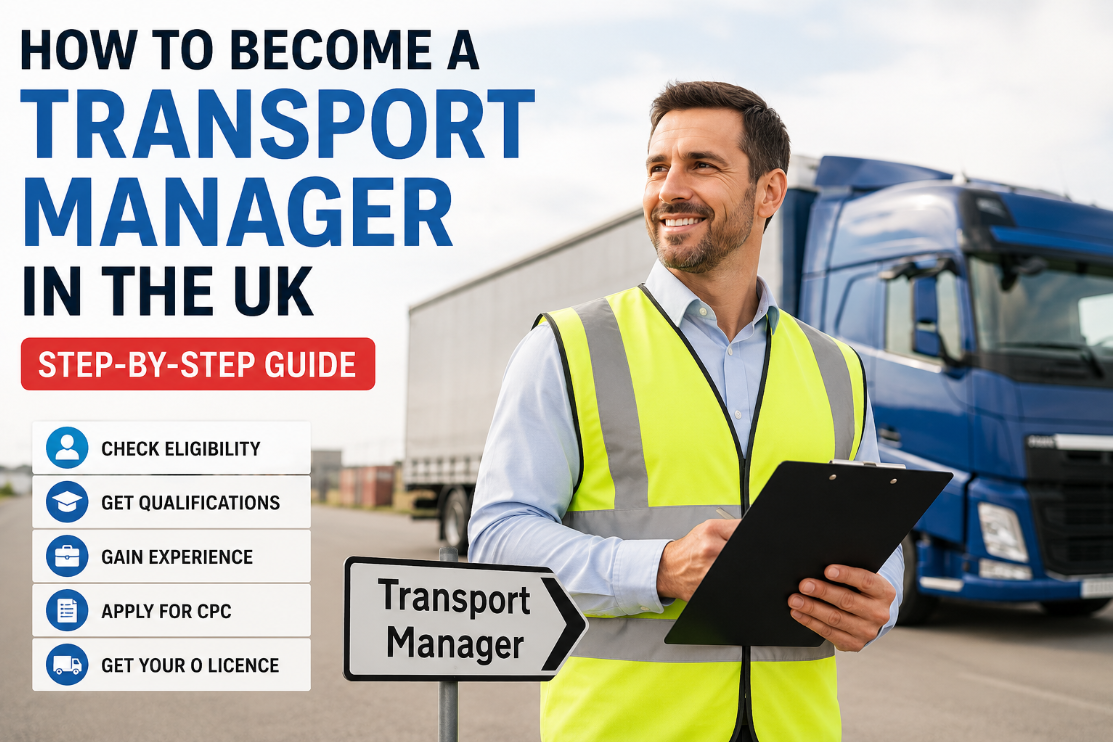

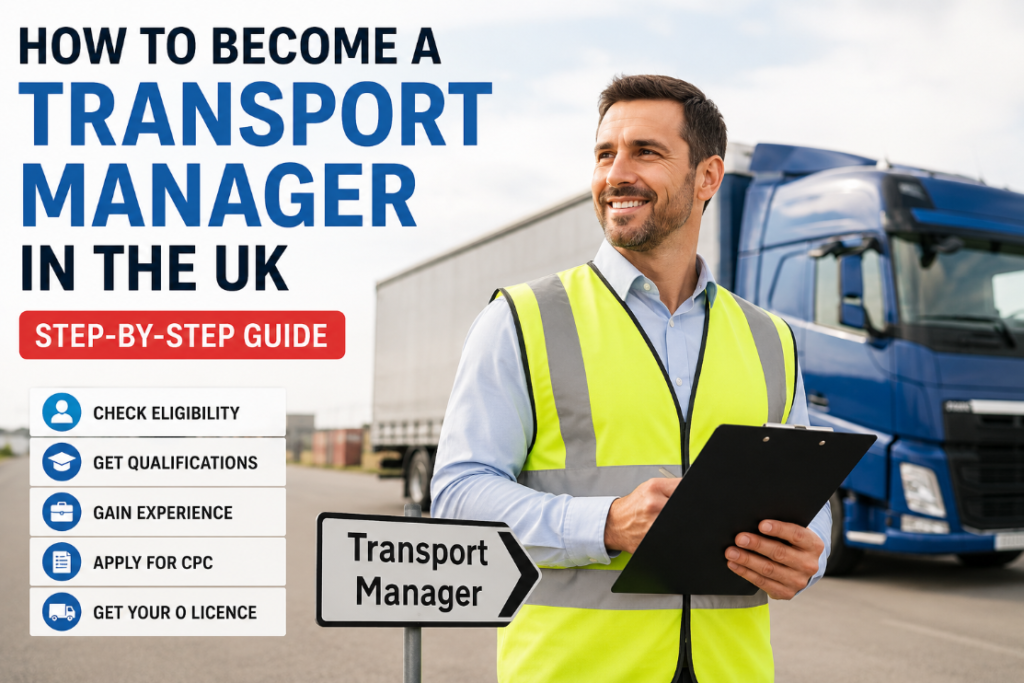
If you work in logistics, haulage, or passenger transport and want to move into a management role, becoming a qualified Transport Manager is one of the most valuable career moves you can make. It’s a legally recognised position, in steady demand, and it puts you in charge of the compliance and operations that keep a fleet on the road. Here’s exactly what the route to qualification looks like, step by step.
Step 1: Understand What a Transport Manager Actually Does
A Transport Manager is the person named on an operator’s licence as “professionally competent” for running vehicle operations. It’s the Transport Manager’s job to ensure the business complies with drivers’ hours rules, vehicle maintenance standards, operator licensing conditions, and health and safety law. Every business holding a Standard National or International Operator’s Licence must have a qualified Transport Manager attached to it, either working in-house or as an external consultant.
Step 2: Decide Which Sector You’re Qualifying For
The qualification splits into two distinct routes, and you need to pick the one that matches your career direction. If you want to work with lorries and goods vehicles, you’ll need the Road Haulage Transport Manager CPC, covering HGV and LGV operations. If your interest is in buses, coaches, and minibuses, you’ll need the Passenger Transport Manager CPC, covering PSV and PCV operations. The syllabus overlaps in areas like operator licensing and drivers’ hours, but each has sector-specific content you’ll be examined on, so choose based on the industry you’re actually working in or want to enter.
Step 3: Check You Meet the Basic Eligibility Requirements
Most training providers require candidates to be at least 18 years old and to have a good enough standard of written and spoken English to follow course materials and sit written exams. There’s no formal entry qualification needed, which makes this an accessible route into transport management even if you’re coming from a driving or operations background rather than a traditional business qualification.
Step 4: Choose Your Route to Professional Competence
There are three recognised routes to gaining professional competence, though one applies to a shrinking number of people:
- The exam route: the most common path. You complete a structured training course, then sit exams regulated by JAUPT (the Joint Approvals Unit for Periodic Training) and OCR. This route is open to anyone regardless of current job title.
- The NVQ/SVQ route: you demonstrate competence on the job over time, typically 12–18 months, while already working in a relevant transport management role. It’s assessed through practical evidence rather than a written exam.
- Grandfather rights: available only to those who held a Transport Manager position continuously for ten years before December 2009. By 2026 this route applies to very few people, since it requires unbroken pre-2010 experience.
For most people starting out, the exam route is the fastest and most practical option.
Step 5: Book a Recognised Training Course
Training courses typically run over 7–10 days, either in intensive blended formats or spread out part-time, and cover the full syllabus: operator licensing, drivers’ hours and tachograph rules, vehicle roadworthiness and maintenance, health and safety, employment law, and financial and commercial management of a transport operation. Make sure the provider is JAUPT-recognised so the course properly prepares you for the OCR-regulated exams.
Step 6: Prepare for and Sit Both Exams
Qualifying means passing two separate assessments: a written multiple-choice exam and a case study exam that tests how you’d apply your knowledge to a realistic transport management scenario. Good preparation includes working through past papers, practising case studies under timed conditions, and taking mock exams that mirror the real format. Both exams need to be passed to gain the qualification, there’s no partial credit for passing only one.
Step 7: Receive Your Certificate of Professional Competence
Once you’ve passed both exams, you’re awarded your Certificate of Professional Competence (CPC). This is a lifetime qualification, it doesn’t expire or need renewing on a fixed cycle, though staying current with regulatory changes through ongoing CPD is considered good practice in the industry.
Step 8: Get Named on an Operator’s Licence
Holding the CPC qualifies you to be named as the professionally competent person on a Standard National or International Operator’s Licence, but you’ll still need to be formally appointed to a specific licence, either as an employed Transport Manager within a business or as an external Transport Manager supporting multiple operators. This is the point where the qualification translates into an actual role and income.
Step 9: Keep Developing Once You’re Qualified
The best Transport Managers treat the CPC as a starting point rather than a finish line. Staying on top of changes to drivers’ hours rules, operator licensing conditions, and enforcement priorities from the Traffic Commissioners keeps you effective in the role and protects the operator’s licence you’re responsible for.
Ready to Start?
Whichever sector you’re aiming for, the fastest route to becoming a qualified Transport Manager is a JAUPT-recognised training course built around the real OCR exam format. Explore our Road Haulage and Passenger Transport Manager CPC courses to find the right starting point for your career.
Sources consulted for regulatory and process details: Transport Manager CPC Complete Guide 2026, Transport Manager CPC Requirements Explained, CILT Transport Manager CPC in Road Haulage.