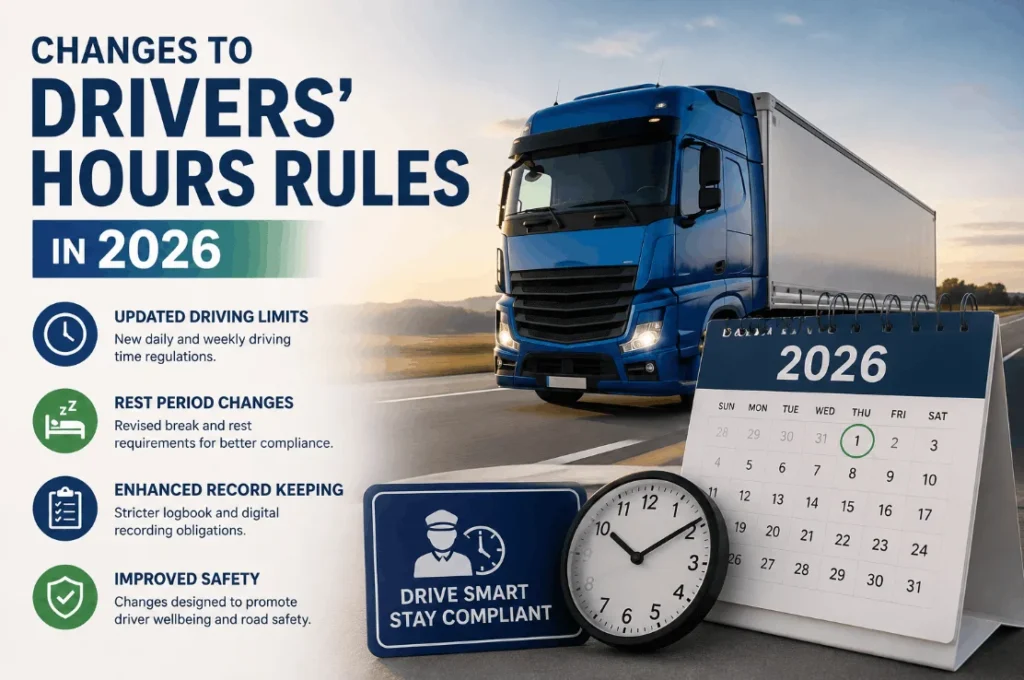
For transport managers and fleet operators, 2026 brings some of the most significant updates to drivers’ hours rules in years, particularly for businesses running international operations. Understanding these changes now helps avoid compliance gaps before they become costly.
The headline change takes effect from 1 July 2026: light commercial vehicles between 2.5 and 3.5 tonnes engaged in international transport or cabotage operations will be brought into scope of drivers’ hours regulations for the first time. Previously, these lighter vans sat largely outside the regime that governed HGVs. Operators running mixed fleets will need to reassess which vehicles now require compliance monitoring, including installation of second-generation Smart Tachographs (Smart Tachograph 2) for qualifying vehicles.
Record-keeping requirements have also tightened. Drivers operating HGVs over 3.5 tonnes on international routes between the UK and EU must now produce 56 days of tachograph records, double the previous 28-day requirement. This applies across digital data, analogue charts, and manual records, meaning operators need robust systems for retaining and retrieving historical data over a longer window.
These shifts follow the broader move away from retained EU regulations toward the AETR framework (the European Agreement concerning the Work of Crews of Vehicles Engaged in International Road Transport), which now governs international journeys following changes introduced in April 2025.
Importantly, the core driving time and rest period rules remain unchanged: the 45-minute break after 4.5 hours of driving, an 11-hour daily rest period (reducible to 9 hours up to three times a week), a 45-hour weekly rest, and driving caps of 56 hours weekly and 90 hours across two consecutive weeks. Businesses operating solely within the UK, with no international journeys, are not affected by the new tachograph and vehicle-scope changes.
For transport managers, the practical takeaway is clear: audit your fleet against the new 2.5 to 3.5 tonne threshold, confirm which vehicles need Smart Tachograph 2 fitted ahead of the July deadline, and update data retention processes to cover the extended 56-day record requirement. Getting ahead of these changes now avoids scrambling to fix compliance gaps once enforcement begins.
Sources:
What is a transport management system and how does it improve fleet operations?
July 23, 2026

How to become a transport manager in the UK: Step-by-Step Guide
July 23, 2026

Essential Skills for Aspiring Transport Managers
June 19, 2026

Benefits of Online CPC Training
June 19, 2026
Changes to Driver’s Hours Rules in 2026
June 19, 2026

CPC Training: Your Path to a Successful Transport Career
June 19, 2026